Rooted Linguistics: Serving Teachers of Multilingual Learners
  • *Home*
    • Rooted Linguistics, LLC
    • Advertising Disclosure
  • Blog
  • Resources
    • Books
    • Infographics
    • Videos
  • Services
  • ABOUT VALENTINA
    • Experience
    • Presentations
Picture


​NEW Resource! 

Welcome to Teaching Multilingual Learners: An Illustrated Guide

Get Your Copy
Picture

Creative Thinking, Accessing Prior Knowledge & More: ABC Brainstorming with MLs

12/19/2023

 
Picture
Accessing prior knowledge is an important element of instruction especially when serving multilingual learners. It doesn’t have to take long, but when implemented it can stimulate thinking and help new learning stick too. 

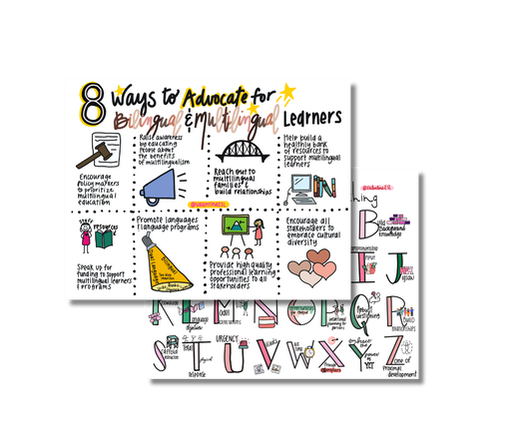
ABC Brainstorming is one way to access prior knowledge, and it can also be used as a culminating activity. ABC Brainstorming can be done in small collaborative groups or it can be done individually. I have found it most effective when introduced first individually for a few minutes and then in small collaborative groups. 
This brainstorming technique is a structured method that provides each learner with an avenue for creative thinking. The organizer helps to methodically focus thinking while also allowing for individual exploration of ideas. It cultivates diversity in responses based on students’ personal experiences and background knowledge. The student-centered approach affirms and validates learners’ funds of knowledge. 

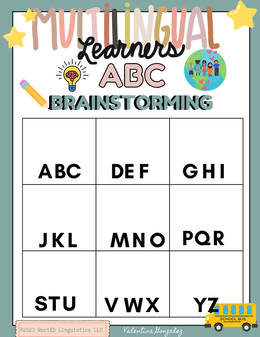
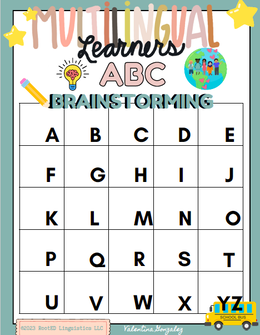
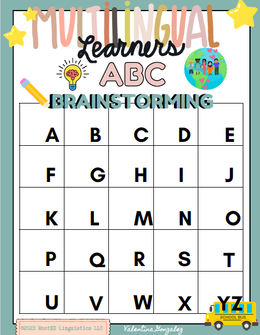
There are several different formats for ABC Brainstorming. The most common includes 26 boxes, and another has nine boxes with roughly 3 letters in each box. 

Here’s how to use the ABC Brainstorming method: 

  1. Before a unit of study, decide which format of the ABC brainstorming best fits your student’s needs. Print a copy for each student or prepare to share it with them digitally.
  2. Share the ABC brainstorming organizer with students and have them brainstorm words and phrases related to the topic. Ask them to work independently for a given time. 
  3. Then put students in groups of four to collaborate on the ABC brainstorming organizer. Give them a given time to try to fill in all of the boxes together. 
  4. Under a document camera or on a SMARTboard, scribe the words that students dictate for each box. 

As students work together and as a class to generate words, they continue to dig deeper into the concepts and learn new vocabulary from their peers. The versatility of the ABC brainstorming method is one of the reasons I find it practical. It can be used at the beginning and end of a unit or lesson with whole groups or small groups. 

In some instances, multilingual learners will add words in languages other than English. I’ve also seen students include sketches or visuals in their brainstorming. All are valid and welcomed responses. 

Overall, ABC brainstorming serves as a practical and engaging language practice activity that supports vocabulary expansion, grammar application, and creative expression for English learners. It can be integrated into language learning curricula to provide a structured and enjoyable way for learners to develop their language skills.

INSTRUCTIONAL COACHES, PD Leaders, AND ADMINISTRATORS, READ BELOW. 


If you deliver professional learning at your campus or district, here’s how you can use this brief article and the PDF to introduce ABC Brainstorming to your colleagues. 

  1. Have the room set up for participants to be seated in groups of 4. 
  2. Print the PDF and have it ready for each participant. 
  3. Have participants fill out the ABC Brainstorming organizer with as many words as they can ON THEIR OWN for about 2 minutes. 
  4. Then ask participants to work together at their table groups to complete the ABC Brainstorming organizer together. Their goal is to fill in all of the boxes and have as many words/phrases as they can come up with. Give them about 3 minutes for this. 
  5. Now take some time to share as a whole group. Under a document camera or on the SMARTboard, scribe as they call out to you the words from their ABC Brainstorming organizers. 
  6. Following this process, debrief with participants. How did the brainstorming feel? What did we go through? How was it helpful? 
  7. Next, turn their attention to what this will look like in the content classroom. How might this work in math, science, history, etc.? We did this at the beginning of our “lesson,” could we do it at the end? 
  8. Have participants read the article above and pick a significant sentence to share with their group. You can print it for them or have them read it online. 
  9. Finally, have participants look at their ABC Brainstorming organizer and add a word or two, and on a sticky note write down how and when they will implement this technique in their classroom. 

Through this process, you have engaged your participants in listening, speaking, reading, and writing! Congratulations. I would love to hear how it went. 

Picture
Picture
Need a print out of the article? Here it is! 
Picture

Comments are closed.

    Subscribe to Newsletter

    ​Archives

    August 2025
    April 2025
    January 2025
    December 2024
    August 2024
    July 2024
    March 2024
    January 2024
    December 2023
    October 2023
    September 2023
    July 2023
    April 2023
    March 2023
    February 2023
    January 2023
    November 2022
    October 2022
    May 2022
    February 2022
    January 2022
    August 2021
    June 2021
    May 2021
    April 2021
    February 2021
    January 2021
    December 2020
    September 2020
    June 2020
    May 2020
    April 2020
    March 2020
    February 2020
    January 2020
    December 2019
    November 2019
    October 2019
    September 2019
    August 2019
    July 2019
    June 2019
    May 2019
    April 2019
    March 2019
    January 2019
    December 2018
    November 2018
    October 2018
    September 2018
    August 2018
    July 2018
    June 2018
    May 2018
    April 2018
    March 2018
    February 2018
    January 2018
    December 2017
    November 2017
    October 2017
    September 2017
    August 2017
    July 2017
    June 2017
    May 2017
    April 2017
    March 2017
    February 2017
    January 2017
    December 2016
    May 2016


    Categories

    All
    Academic Conversations
    Academic Vocabulary
    Accommodating
    Accommodations
    Administrator
    Advocacy
    Anchor Chart
    Art
    Assumptions
    Balanced Literacy
    Beginning Of The Year
    Bloom's Taxonomy
    Book Study
    Brain Research
    Building Background
    Building Relationships
    Collaboration
    Communication
    Comprehensible Input
    Conferences
    Conferring
    Connecting With ELL Families
    Content Objectives
    Cooperative Learning
    Cooperative Strip Paragraph
    Coteach
    CoTeacher
    Co Teaching
    Co-teaching
    Courses
    Creativity
    Critical Thinking
    CRT
    Culturally Responsive Teaching
    Curriculum
    Differentiate
    Differentiation
    Discourse
    Distance Learning
    Diverse Books
    DOL
    Ear To Ear Reading
    ELLs
    ELPS
    Empathy
    End Of The Year
    Engaging
    English Learners
    ESL
    Exit Criteria
    Expression
    Fluency
    Foundations
    Four Cs
    Games
    Getting To Know Your ELLs
    GLAD
    Goal Setting
    Gradual Release
    Guided Math
    Immigrant
    Instructional
    Interactive Lecture
    Interactive Read Aloud
    Interactive Word Walls
    Language Development
    Language Level
    Language Objectives
    Language Rich
    Language Structures
    Leaders
    Learning Walks
    Lesson Planning
    Levels
    Library Media Specialist
    Linguistic
    Listening
    Literacy
    Long Term ELs
    Maslow's Hierarchy
    Math
    Memory
    Misconceptions
    Model
    Modeling
    Multilingual
    Native Language
    New ESL Teacher
    Nonfiction
    Observation
    Observation Charts
    Online PD
    Oral Language
    Paraprofessional Educators
    Parent Teacher Conference
    Personalized Learning
    Phonics
    Picture Word Inductive Model
    Planning Instruction
    PLDs
    PLN
    Primary Language
    Principals
    Procedural
    Professional Development
    Professional Learning Network
    Programs
    Q Triple S A
    Readers' Workshop
    Reading
    Reading Workshop
    Revising & Editing
    Scaffolding
    Science Of Reading
    Secondary
    Sentence Patterning Chart
    Sentence Starters
    Sentence Stems
    Shared Writing
    Sheltering Instruction
    Sketchnotes
    Small Group
    Social Studies
    Somebody Wanted But So
    Structured Conversations
    Summarization
    Summer
    Supporting ELLs
    SWBS
    Systematic Change
    Talk
    Talking Heads
    Teacher
    The Power Of Talk
    Toolkit
    Total Physical Response
    TPR
    Twitter
    UDL
    Verbal
    Virtual Learning
    Visuals
    Vocabulary
    Wait Time
    WIDA Can Do
    Workshop
    Writers' Workshop
    Writing
    Writing Workshop

    RSS Feed

    Picture
    Tweets by ValentinaESL

Articles

Resources

Contact

Email
COPYRIGHT @ 2023.VALENTINA GONZALEZ ALL RIGHTS RESERVED.
  • *Home*
    • Rooted Linguistics, LLC
    • Advertising Disclosure
  • Blog
  • Resources
    • Books
    • Infographics
    • Videos
  • Services
  • ABOUT VALENTINA
    • Experience
    • Presentations