|

|
|
|
|
 SHOW Your Thinking: A Simple Framework for Building Oral Language and Listening Skills Long before a student can write a strong paragraph, they need to be able to talk one through. Oral language is the foundation on which everything else in literacy is built: vocabulary, sentence structure, reasoning, even reading comprehension all trace back to a student's ability to put thoughts into words and follow someone else's. Yet in a busy classroom, it's easy for talk to get reduced to quick answers: a raised hand, a one-word response, a nod that a teacher hopes means understanding. Real thinking rarely fits in one word.
That's the gap the SHOW method is built to close. 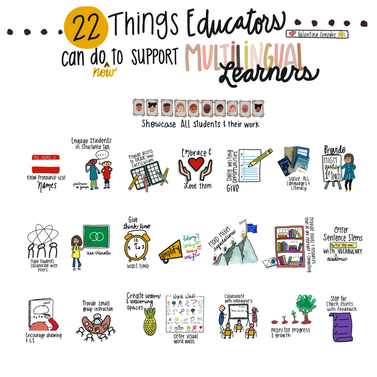 Multilingual learners count on us to provide high-quality, comprehensible, and culturally responsive instruction in each lesson in every classroom.
Here are 22 practical and efficient ways (in no particular order) we can support emergent bilinguals as they climb to become our future global leaders. *The terms multilingual, emergent bilingual, and English learner are used interchangeably in this article and also include the acronyms MLs, EBs, and ELs. 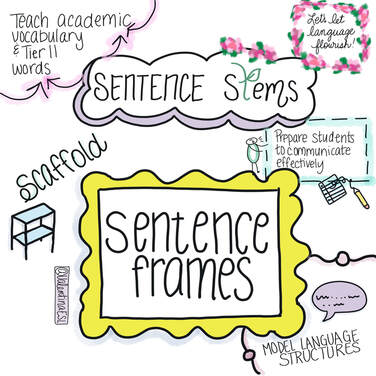 What is the difference and Why should we care?Well, first and foremost, we should care if we want our students to speak like scholars. If we want our students to be marketable after they graduate. If we want them TO graduate! Then we should care! Sentence stems and frames are scaffolds as students learn language and content.
Sometimes educators use the terms sentence stems, sentence starters and sentence frames interchangeably. You may wonder...are they the same thing? The answer is no, they are are not the same. They have their own form and function. 
A huge part of balanced literacy and a workshop setting is conferring with students. Conferring allows for maximum differentiation to meet specific instructional needs for students. But when we serve students who are also learning English, there is a need to accommodate the way we confer. After years of conferring with ELLs and tons of reading in the field, here are my tips for conferring with ELLs.
 1. Model
Each kid benefits from seeing how to write before they DO the writing. BUT for English Learners this is even more important because language structures may vary from their native language. For example, if I want my students to write about themselves describing their age, I might show them that in English we write: " I am nine years old." This is different from other languages like my native language where a person might say, "I have nine years." Modeling what we expect from students gives them a clear goal for their writing. 2. Be Explicit |
Categories
All

|
 RSS Feed